Tim Dolch Joins National Effort to Listen for Ripples in Spacetime
August 21, 2026
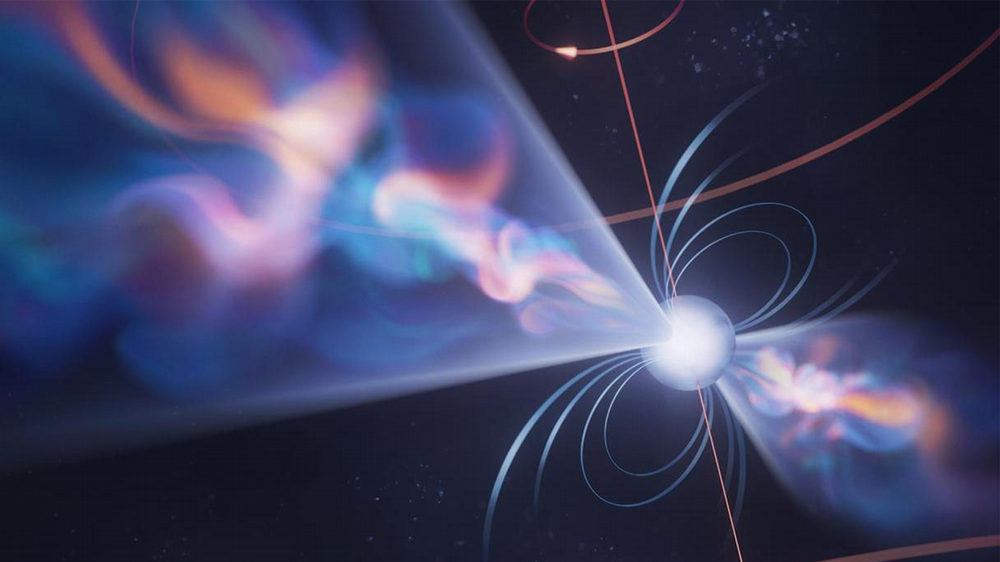 Energetic particles are accelerated along a pulsar's open magnetic field lines, producing radio emission. As the pulsar rotates, our radio telescopes detect this beamed emission as precisely periodic radio pulses. Illustration: Olena Shmahalo
A new University of New Mexico faculty member is joining a national research effort aimed at better understanding one of the universe’s most mysterious phenomena: gravitational waves.
 Timothy Dolch, an associate professor in UNM’s Department of Physics and Astronomy, is part of the North American Nanohertz Observatory for Gravitational Waves (NANOGrav) Collaboration, which recently received $5.9 million from the National Science Foundation (NSF) to continue research into low-frequency gravitational waves.
Approximately $100,000 of the award will support research at UNM beginning this fall.
Dolch and a graduate student at UNM will work to improve observations of pulsars — rapidly rotating neutron stars that emit regular pulses of radio waves — making them more sensitive detectors of gravitational waves.
See the UNM Newsroom article: UNM researcher joins national effort to listen for ripples in spacetime