10 Years of Observing the (Mostly) Dark Side of the Universe with LIGO, the World’s Largest Quantum Sensor
- Physics and Astronomy Colloquium
January 30, 2026 3:30 PM -
January 30, 2026 4:30 PM
PAIS 1100
- Host:
- Paco Salces Carcoba
- Presenter:
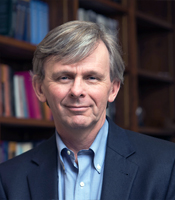
- David H. Reitze | Director, LIGO Lab
The first direct detection of gravitational waves from a pair of colliding black holes in 2015 ago opened a new window to the high energy universe. Since 2015 the LIGO-Virgo-KAGRA international gravitational-wave detector network has observed hundreds of events, mostly pairs of black holes but also binary neutron star mergers as well as neutron star - black hole collisions. The information revealed in these detections is changing our understanding of the Universe.
This talk will cover the fundamentals of gravitational-wave detection, present recent highlights from LIGO-Virgo-KAGRA observing runs, and discuss what they reveal about the cosmos. Time permitting, we'll also look at the future generation of gravitational-wave observatories being planned for the next decade that are being designed to probe the entirety of the Universe.
About David Reitze
My research program is centered broadly on gravitational-wave physics and astronomy, and specifically on the development and operation of current and future gravitational-wave detectors and on understanding what gravitational wave astronomy tells us about the universe. This includes gravitational-wave astrophysics, investigations of thermal effects in interferometers, development of high power optical components, as well as the design, construction, and operation of the LIGO interferometers located in Hanford, WA and Livingston, LA.